Showing posts with label toys. Show all posts

Friday, December 7, 2012

Paper Bag Stuffed Teddy Bears


Children color, stuff and sew their own teddy bears! Not only do the children have a lot of fun making this craft, but it also helps develop their fine motor skills. Before starting this craft, please note, it does require some, or a lot, of preparation, depending on the ages of the children you are working with. Also, it is recommended you prepare for this craft the day before you plan to complete it. 

Materials:
  • Paper Bag
  • Scissors
  • Pencil
  • Glue
  • Crayons, color pencils, markers or paint
  • Single hole punch
  • Yarn or any other string like material children can use to sew
  • Cotton balls or stuffing 
Directions:
1. With scissors, cut a paper bag so it can be opened a laid flat 


2. Fold the paper bag in half. 

3. Draw the outline of an entire teddy bear on each half of the paper bag. 


4. Using scissors, cut the outlines of the teddy bears out of the bag. You should have 2 teddy bear outlines. Draw an outline of the bear's face on one of the cutouts. This will be the front of the teddy bear. The other side (without the drawn face) will be the back of the teddy bear. 



5. Have the children cut the scrap pieces of the paper bag into small pieces. This will later be used as stuffing.


6. Glue at least one half of the two teddy bear cut outs together. It is recommended that you use liquid glue and allow the glue to dry overnight to make stuffing the bears easier for the children. Allow the glue to dry before continuing to the next step. 


7. Using a single hole punch, make holes along the edge of the teddy bear. 


8. Color the teddy bear. 
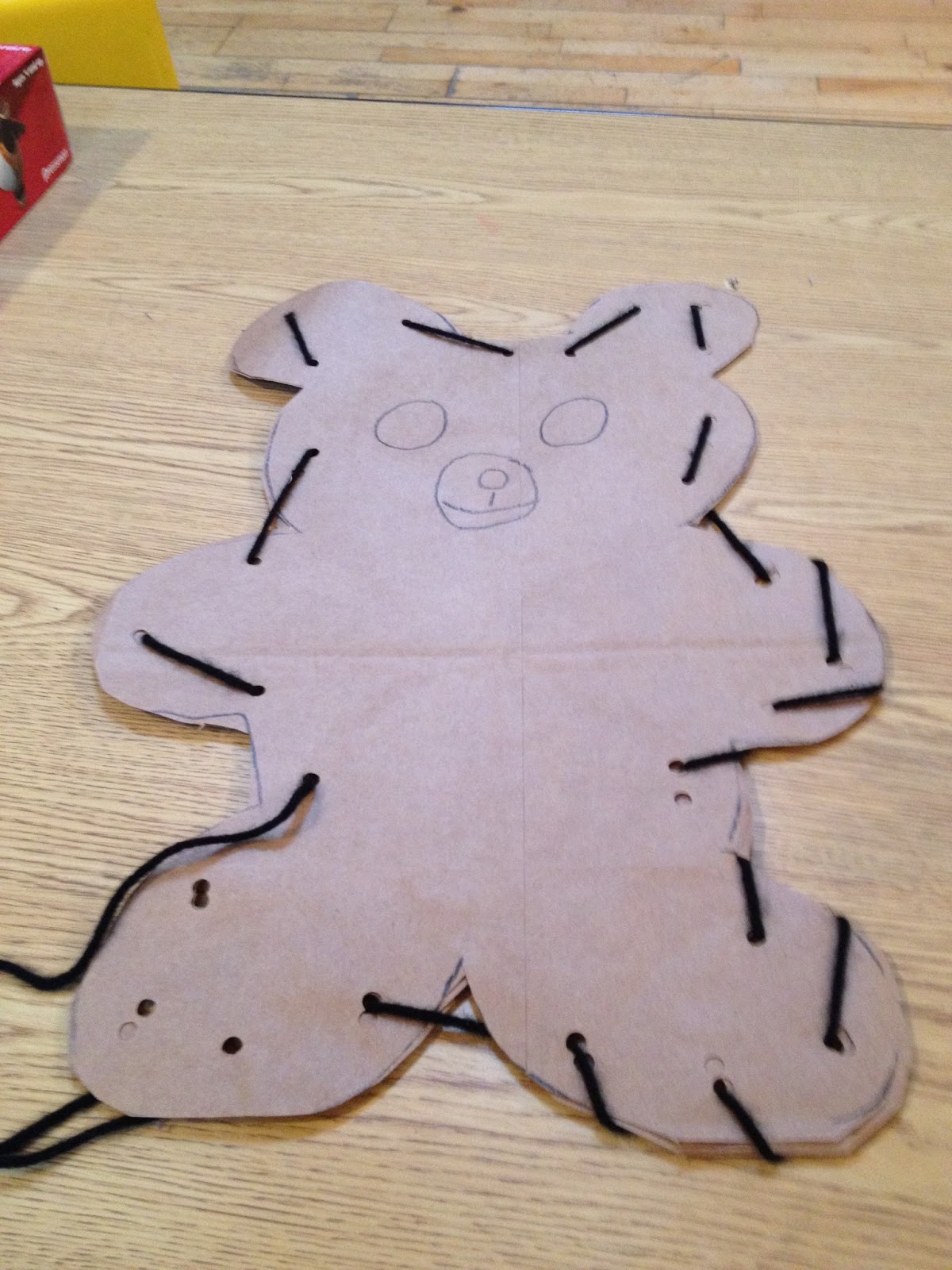

9. Using yarn, have the children sew the bear by pulling the yarn through the holes with their fingers. At this step, only have them sew the part of the bear that is glued together. 


10. Help the children stuff the bear with cotton stuffing and the scraps of the paper bag. 


11. When the bear is completely stuffed, glue the unsealed part together. Allow to dry. 

12. Have the children finish sewing the bear together. 

Tuesday, November 27, 2012

Toy Safety


Did you know that, according to the American Academy of Pediatrics, approximately 300 children under the age of 4 years die every month in the United States because of accidents? On top of that thousands of more children are injured. All of these injuries and deaths can be prevented with simple steps.

Believe it or not, toys can be a health risk to children, if they are not handled, stored or used correctly. Common hazards include choking, cuts, and hearing damage.

To prevent these hazards:
1.     Select toys that are safe and developmentally appropriatefor your child.
·        When selecting toys, look for the UL Approvedstamp. Underwriter Laboratories (UL) is an independent company that verifies thesafety of children’s toys
·        Read labels and make sure the toy is ageappropriate for your child
·        Some common toy hazards to avoid: sharp edges,loud noises and strings greater than 7 inches in length
·        Some age appropriate toys

Age
Examples of toys
Infants (0-12 months)
Large plastic blocks, rattles, soft washable toys, busy boards, and squeeze toys
Toddlers (1-2 years)
Cloth or plastic books, sturdy dolls, nesting blocks, push and pull toys, and stacking toys
Preschoolers (2-5 years)

Books, crayons, blackboards, chalk, housekeeping toys, building blocks, and  simple puzzles

2.     Maintain your child’s toy and make any repairsto damaged toys.
·        Children can choke on loose buttons and beads
·        If your wooden toys has a chipped corner, yourchild can get cuts from it

3.     Store your child’s toys away from where yourchild walks and runs in secure bins.
·        Your child can choke on toys that have danglingstrap greater than 7 inches long
·        If you store toys in a cupboard on a shelf, makesure there are no hanging strings or straps. If your child pulls on a danglingstrap, he or she can be injured if the entire cupboard falls on him or her.  

4.     And always supervise your child during play.  

We will continue to post child safety and protection tips throughout November. Visit us soon to stay posted!

References:
American Academy of Pediatrics: http://www.aap.org 

Hearron, Patricia. Management of Child Development Centers. Pearson Higher Education (2007).

Herr, Judy. Working With Young Children. Goodheart-Wilcox (2008).

www.safety.com. General, updated information (2010).